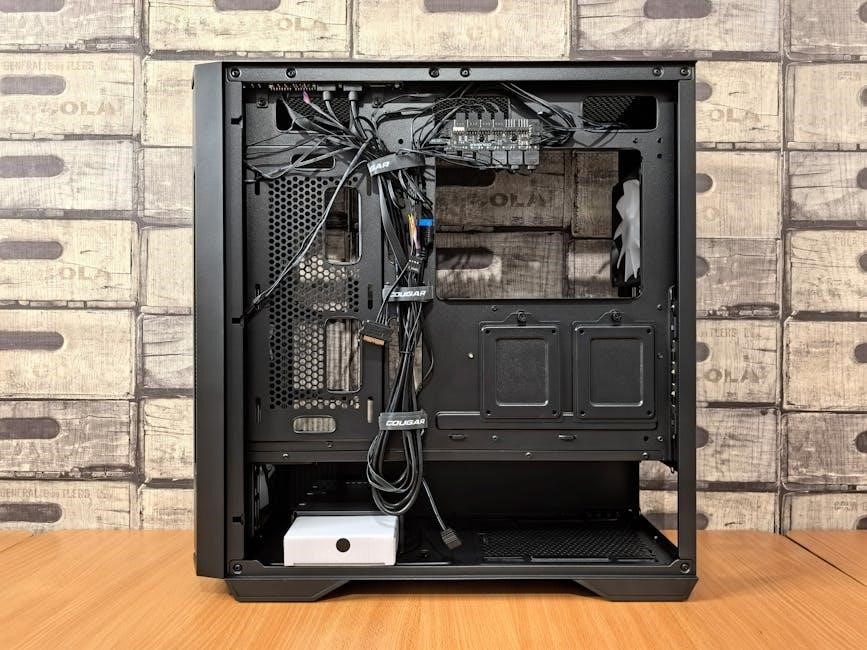
The HPE 450e Tower Desktop PC is a powerful, flexible system, designed for businesses and specialists, bringing AI, cloud, and networking together.
Overview of the System
The HPE 450e Tower Desktop PC represents a significant offering in essential enterprise technology. It skillfully integrates the capabilities of Artificial Intelligence, cloud computing, and advanced networking solutions. This system is meticulously engineered to empower organizations in achieving ambitious goals and tackling complex challenges. HPE’s dedication to innovation shines through, delivering a versatile platform suitable for diverse workloads and demanding environments, from edge to cloud.
Target Users: Businesses and Specialists
The HPE 450e Tower Desktop PC is strategically designed for both dynamic businesses and discerning specialists. It caters to organizations needing robust computing power for tasks like data analysis and application hosting. Simultaneously, it supports professionals requiring high performance for specialized applications, including AI and machine learning endeavors; HPE delivers a solution adaptable to varied professional needs.

Unboxing and Initial Setup
Carefully verify package contents, inspect physical components for damage, and then proceed with powering on the system for the initial boot process.
Package Contents Verification
Upon receiving your HPE 450e Tower Desktop PC, meticulously verify all included items against the packing list. Ensure the presence of the desktop unit itself, power cord, and any accompanying documentation – like the setup manual and warranty information. Check for included accessories such as mounting brackets or optional components ordered separately. Report any discrepancies or missing items immediately to HPE support or your reseller to ensure a complete and functional system setup.
Physical Component Inspection
Before powering on, carefully inspect the HPE 450e’s exterior for any signs of shipping damage – dents, scratches, or loose panels. Gently check all ports and connectors for secure attachment. Open the chassis (refer to the manual!) to visually confirm internal component seating; RAM, storage, and expansion cards. Document any pre-existing issues with photos before proceeding, and contact support if concerns arise.
Powering On and Initial Boot
Connect the power cable securely to the HPE 450e and a grounded outlet. Press the power button; observe the power LED illuminating. The system should initiate POST (Power-On Self-Test), displaying initial messages on the screen. If no display appears, verify monitor connection and power. Allow the system to boot to the BIOS/UEFI setup or the pre-installed operating system.

Hardware Components – Detailed Look
The HPE 450e features compatible processors, various RAM options, and diverse storage choices like HDD, SSD, and NVMe for optimal performance.
Processor Specifications and Compatibility
The HPE 450e Tower supports Intel processors, offering a range of options to suit diverse workloads. Compatibility extends to various Intel generations, ensuring future-proofing and performance scalability. Specific processor support details, including socket types and TDP ranges, are crucial for optimal system configuration. Refer to the HPE documentation for a comprehensive list of tested and supported processors, guaranteeing stability and maximizing the system’s processing capabilities.
Memory (RAM) – Types, Capacity, and Installation
HPE 450e Tower utilizes DDR4 memory, supporting various speeds and capacities to enhance performance. The system features multiple DIMM slots, allowing for easy upgrades and expansion. Maximum supported RAM capacity varies based on processor and system board configuration – consult the manual for specifics. Proper installation involves aligning the notch and applying even pressure, ensuring secure and reliable operation.
Storage Options: HDD, SSD, and NVMe
The HPE 450e Tower supports diverse storage solutions, including traditional Hard Disk Drives (HDDs) for capacity, Solid State Drives (SSDs) for speed, and NVMe SSDs for maximum performance. Multiple bays accommodate various form factors. NVMe drives utilize the PCIe interface, offering significantly faster data transfer rates. Choosing the right storage depends on your specific needs and budget.
Expansion Slots: PCIe and their Uses
The HPE 450e Tower features PCIe expansion slots, enabling users to enhance functionality. These slots support graphics cards for improved visuals, network adapters for faster connectivity, and storage controllers for additional drives. Different PCIe versions (Gen3, Gen4) offer varying bandwidths. Carefully consider your expansion needs when selecting compatible PCIe cards for optimal performance.

Connectivity and Ports
The HPE 450e offers diverse connectivity, including USB, Ethernet, and video outputs, alongside wireless options like Wi-Fi and Bluetooth for versatile use.
Front Panel Ports: USB, Audio
The HPE 450e’s front panel provides convenient access to essential ports. Typically, you’ll find multiple USB ports – including USB Type-A for peripherals and potentially USB-C for faster data transfer and charging. A combined audio jack accommodates headphones and a microphone, simplifying connections for multimedia and communication. These readily available ports enhance usability and streamline daily operations, offering quick access for frequently used devices and accessories.
Rear Panel Ports: USB, Ethernet, Video Outputs
The HPE 450e’s rear panel offers a comprehensive array of connectivity options. Expect numerous USB ports for diverse peripherals, a robust Ethernet port for reliable network access, and video outputs like DisplayPort or HDMI to connect to monitors. These ports facilitate seamless integration with various devices, ensuring optimal performance for both office productivity and specialized tasks, supporting high-resolution displays and fast data transfer speeds.
Wireless Connectivity: Wi-Fi and Bluetooth
The HPE 450e typically incorporates integrated Wi-Fi capabilities, enabling seamless connection to wireless networks for convenient internet access. Bluetooth functionality is also standard, allowing for effortless pairing with wireless peripherals like keyboards, mice, and headsets. This wireless freedom enhances productivity and reduces cable clutter, providing a versatile computing experience for modern work environments.

Operating System Installation & Management
HPE 450e supports various operating systems; BIOS/UEFI configuration is key, alongside driver installation and regular updates for optimal performance.
Supported Operating Systems
The HPE 450e Tower Desktop PC demonstrates broad compatibility with prevalent operating systems, ensuring flexibility for diverse user needs. Officially supported options include Windows 10 and Windows 11, both 64-bit versions, providing a modern and secure computing experience. Linux distributions, such as Red Hat Enterprise Linux, SUSE Linux Enterprise Server, and Ubuntu, are also validated for optimal performance. HPE continually updates its support list, so checking the official HPE documentation for the latest compatible OS versions is recommended before installation.
BIOS/UEFI Configuration
Accessing the BIOS/UEFI settings on the HPE 450e is typically achieved by pressing a designated key – often F10 – during the system’s startup sequence. Within the UEFI interface, users can configure boot order, hardware settings, and security features. Careful adjustment of these parameters is crucial for optimal system performance and stability. Refer to the HPE documentation for detailed guidance on navigating and modifying specific BIOS/UEFI options, ensuring correct configuration for your operating system and hardware.
Driver Installation and Updates
Ensuring proper driver installation is vital for the HPE 450e’s functionality. HPE provides drivers via their Support Center Portal, categorized by operating system and component. Regularly updating these drivers—for networking, graphics, and other hardware—optimizes performance and resolves compatibility issues. The HPE Support Assistant tool can automate this process, simplifying driver management and ensuring your system operates with the latest, most stable versions available from Hewlett Packard Enterprise.

HPE Management Tools
HPE offers robust management tools like iLO, OneView, and Support Assistant, enabling remote management, integration, and streamlined support for the 450e.
HPE iLO (Integrated Lights-Out) – Remote Management
HPE iLO is a key feature, providing remote server management even when the operating system is down. Access power control, monitor health, and perform virtual media mounting remotely. iLO enhances efficiency by allowing administrators to manage the 450e from anywhere, reducing on-site visits and improving responsiveness to critical issues. It’s a powerful tool for proactive maintenance and troubleshooting.
HPE OneView Integration
HPE OneView simplifies management of the 450e within a larger infrastructure. This tool provides a single interface for provisioning, monitoring, and updating connected HPE hardware. OneView automates tasks, reducing manual effort and potential errors. It streamlines deployment and configuration, enabling faster time-to-value and improved operational efficiency for enterprise environments.
HPE Support Assistant
HPE Support Assistant proactively monitors system health, providing alerts and recommendations for optimal performance of your 450e. It delivers quick access to drivers, firmware, and documentation, simplifying updates and troubleshooting. This tool automates support tasks, reducing downtime and improving IT efficiency. Accessing HPE’s extensive knowledge base is streamlined through this assistant.
Troubleshooting Common Issues
Addressing typical problems like no power, display issues, or network connectivity, this section guides users through diagnostics and resolutions for the 450e.
No Power/Boot Issues
If the system fails to power on, verify the power cord is securely connected to both the PC and a working outlet. Check the power supply switch on the rear panel.
If power is present but the system doesn’t boot, ensure all internal connections are firm, including the power cables to the motherboard and drives.
Consult the HPE Support Center for detailed troubleshooting steps and potential component diagnostics.
Display Problems
If experiencing display issues, first confirm the monitor cable (HDMI, DisplayPort) is securely connected to both the PC and the monitor. Verify the monitor is powered on and set to the correct input source. Try a different cable or monitor to isolate the problem.
Check device manager for driver issues, and update graphics drivers via HPE Support Center.
Network Connectivity Issues
Troubleshooting network problems begins with verifying the Ethernet cable connection to both the PC and the network device (router, switch). Confirm network device functionality. Check the network adapter is enabled in BIOS/UEFI and the OS. Update network drivers through HPE Support Center. Ensure correct IP address configuration or DHCP is enabled.

System Cooling and Thermal Management
Effective thermal management is crucial for system stability; monitor fan speeds and optimize airflow, regularly removing dust to maintain optimal operating temperatures.
Fan Configuration and Monitoring
The HPE 450e utilizes a strategically designed fan system for optimal cooling. Access BIOS settings to monitor fan speeds and adjust profiles for quiet operation or enhanced performance. Regularly check fan functionality; ensure proper airflow isn’t obstructed by dust or cables. The system’s health dashboard provides real-time temperature readings and alerts for potential overheating, allowing proactive maintenance and preventing component damage. Proper fan operation is vital for long-term reliability.
Airflow Optimization
Optimal airflow within the HPE 450e is crucial for thermal management. Ensure cables are neatly routed to avoid blocking vents. Position the tower with adequate space around all sides for unrestricted air intake and exhaust. Consider ambient room temperature; hotter environments require increased cooling. Regularly inspect for dust accumulation, which significantly restricts airflow and reduces cooling efficiency, potentially leading to performance throttling.
Dust Removal and Maintenance
Regular dust removal is vital for the HPE 450e’s longevity. Power down and disconnect the system before cleaning. Use compressed air to gently remove dust from fans, heatsinks, and vents. Avoid using a vacuum inside the case. Inspect fan blades for debris. Consider a schedule – every 3-6 months – depending on the environment. Proper maintenance ensures optimal thermal performance and prevents component overheating.

Security Features
The HPE 450e offers physical security options, BIOS security settings, and supports data encryption, protecting sensitive information and ensuring system integrity.
Physical Security Options
The HPE 450e Tower incorporates several physical security measures to deter theft and unauthorized access. These include a standard Kensington-style lock slot, allowing users to physically secure the system to a desk or other stationary object. The robust chassis construction itself provides a degree of tamper resistance. Furthermore, consider implementing workplace security protocols, such as controlled access to server rooms or offices, to enhance overall physical protection of the valuable hardware and data contained within the HPE 450e.
BIOS Security Settings
The HPE 450e’s BIOS/UEFI offers robust security features. Administrators can set a supervisor password to restrict access to system configuration. Boot order control prevents unauthorized booting from external devices. HP Sure Start Gen6, integrated within the BIOS, protects the system from BIOS corruption. Secure Boot ensures only trusted operating systems load. These settings, accessible during startup, are crucial for maintaining system integrity and preventing malicious software from compromising the core system functions.
Data Encryption Support
The HPE 450e supports various data encryption methods to safeguard sensitive information. It’s compatible with self-encrypting drives (SEDs), offering hardware-based encryption. Additionally, the system supports software-based encryption solutions, enabling full-disk encryption for the operating system and data. These features, combined with strong BIOS security, ensure data remains protected both at rest and in transit, meeting stringent security requirements for businesses.
Upgrading the System
The HPE 450e allows for CPU, RAM, and storage upgrades, enhancing performance and extending its lifespan to meet evolving business demands effectively.
CPU Upgrade Considerations
When upgrading the HPE 450e’s CPU, ensure compatibility with the motherboard socket and chipset. Check the HPE documentation for supported processor families and TDP (Thermal Design Power) limits. A higher TDP may necessitate an upgraded cooling solution. Verify BIOS support for the new CPU; an update might be required before installation. Consider the power supply’s capacity to handle the increased power draw of a more powerful processor, ensuring stable operation and preventing system instability.
RAM Upgrade Guidelines
Upgrading the HPE 450e’s RAM requires identifying the supported memory type (DDR4, DDR5) and speed specified in the system documentation. Ensure the new RAM modules match these specifications for optimal performance. Install RAM in pairs to enable dual-channel memory access, boosting bandwidth. Check the maximum supported RAM capacity of the motherboard and BIOS. Properly ground yourself to prevent electrostatic discharge during installation, safeguarding the components.
Storage Upgrade Paths
The HPE 450e supports diverse storage options: HDD, SSD, and NVMe drives. Adding a secondary drive is straightforward, utilizing available 2.5” or 3.5” bays. NVMe SSDs offer the fastest performance, connecting via M.2 slots. Ensure compatibility with the motherboard’s interface. Back up existing data before any storage upgrade. Consider RAID configurations for data redundancy and improved performance, consulting the system manual for setup.

Power Supply and Efficiency
The HPE 450e’s PSU delivers reliable power, featuring energy-efficient design. It supports essential components, optimizing power usage for reduced operational costs and environmental impact.
Power Supply Unit (PSU) Specifications
The HPE 450e Tower Desktop PC incorporates a highly efficient Power Supply Unit (PSU) designed to deliver stable and reliable power to all system components. Specific wattage varies based on configuration, typically ranging from 180W to 650W, ensuring compatibility with diverse hardware setups.
It features active Power Factor Correction (PFC) for improved energy efficiency and reduced harmonic distortion. The PSU is 80 PLUS certified, guaranteeing a minimum efficiency level, and offers comprehensive protection features including over-voltage, under-voltage, over-current, and short-circuit protection.
Energy Efficiency Features
The HPE 450e Tower Desktop PC prioritizes energy conservation through several key features. The 80 PLUS certification of its PSU ensures minimal energy waste during power conversion. Intelligent fan control dynamically adjusts cooling based on system load, reducing power consumption.
Furthermore, HPE’s design focuses on component selection for optimal efficiency, contributing to a lower total cost of ownership and a reduced environmental footprint, aligning with sustainability goals.

Warranty and Support Information
HPE offers various warranty options and comprehensive support resources, including documentation, software downloads, and a dedicated support portal for assistance.
HPE Warranty Options
HPE provides a range of warranty services tailored to meet diverse business needs. These options extend beyond the standard coverage, offering enhancements like on-site support, next-business-day response, and extended terms—up to five years. Customers can select warranties covering parts, labor, or a combination of both, ensuring minimized downtime and maximized system uptime. Detailed warranty terms and conditions are available within the product documentation and through the HPE Support Center portal, allowing informed decisions based on specific requirements.
Accessing HPE Support Resources
HPE offers comprehensive support through its Support Center Portal, providing access to product manuals, software downloads, and driver updates. Users can search a vast knowledge base, manage support cases, and engage with community forums for peer-to-peer assistance. Direct access to HPE experts is also available via phone or online chat, ensuring prompt resolution of technical issues and maximizing system performance. These resources are designed for business, enterprise, and IT users.
HPE 450e in Enterprise Environments
The HPE 450e plays a crucial role in edge computing, cloud integration, and AI/Machine Learning applications, powering advancements across various industries.
Role in Edge Computing
HPE 450e excels in edge computing by bringing processing power closer to data sources, reducing latency and bandwidth needs. This is vital for applications like autonomous vehicles and remote monitoring. Its robust design and reliable performance ensure consistent operation in challenging environments. The system supports essential technologies, enabling real-time data analysis and faster decision-making at the edge, ultimately improving operational efficiency and responsiveness for businesses.
Integration with Cloud Solutions
The HPE 450e seamlessly integrates with leading cloud solutions, offering a hybrid IT approach. This allows businesses to leverage cloud scalability and flexibility while maintaining on-premise control. It supports data synchronization and application deployment across environments, enhancing agility and reducing costs. HPE’s cloud integration simplifies management and provides a unified view of IT resources, fostering innovation and accelerating digital transformation.
AI and Machine Learning Applications
The HPE 450e empowers AI and machine learning initiatives with its robust processing capabilities and support for accelerated computing. It facilitates data analysis, model training, and deployment for applications like predictive maintenance and fraud detection. HPE’s solutions optimize performance for AI workloads, enabling faster insights and improved decision-making, driving innovation across various industries.
Leave a Reply